In connection with the annually announced competition for young composers, the organizing team of the Eternal Hope festival endeavors to follow the first steps of emerging performing artists in general. At the beginning of June, chance thus led me to a morning concert matinee of the Prague Philharmonia intended for the residents of Prague 8. The repertoire was classical: Prokofiev, Mahler, Schumann, Mendelssohn, Beethoven.
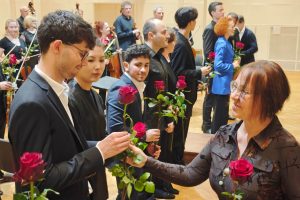
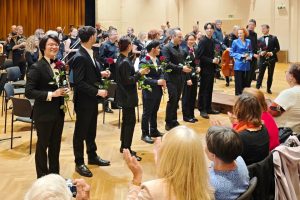
What was unusual was that not only every piece, but even individual movements were conducted by a different young man or young woman, clearly of various nationalities. The explanation was simple in the end. These were ten graduates of the International Conducting Masterclasses led by the German music pedagogue Georg Christoph Sandmann, organized by the Prague-based platform International Conducting Masterclasses.
The second and greater surprise came when, at one point, Joshua Raskin from New York, freshly twenty years old, leaped onto the conductor's podium, a small yarmulke shining on the crown of his head. In our part of the world, its use outside of events associated with the Jewish community is not common. Naturally, the "Pilgrims' March" from Mendelssohn's Italian Symphony was excellently executed under his baton and earned sincere applause. All of this invited the opening of a conversation.
What motivated you to participate in the conducting masterclass in Prague, and why did you choose the course of Professor Sandmann in particular?
First, I worked with Professor Sandmann in Milan in November of last year. At that time, my connection to music was deeply emotional and expressive. However, Professor Sandmann taught me an important thing: although an emotional understanding of music is essential, it does not by itself make one an effective conductor. He showed me that conducting is essentially an act of communication. A conductor can feel the music deeply, but he must also be able to convey these ideas clearly and effectively to the musicians.
The masterclass lasted only a week, which was very demanding. What did it enable you to achieve?
The course was a gift I had been waiting for for a long time. Standing in front of a large, prestigious orchestra six days in a row, at such a young age, was truly a dream come true. This experience helped me a great some. My understanding of orchestration, musical gesture, conducting technique, active listening, and practical collaboration with musicians grew more in a single week than I could have ever imagined. I left the masterclass a different conductor than I was when I entered. The collegial, welcoming, and pleasant atmosphere of the classes is also evidenced by the moment when the orchestra surprised me during a rehearsal, on the right day, with an unexpected fanfare of "Happy Birthday". It was one of the most touching and happiest moments of my life.
Did you have the opportunity to get to know Prague during your week-long stay?
The city absolutely fascinated me. Its architecture and history are beautiful and profound, but what struck me the most was the atmosphere created by the people. I was moved by a sense of contentment, warmth, and appreciation for everyday life that I encountered all over the city. Coming from the United States, I found this perspective refreshing and inspiring. The people of Prague and the Czech Republic showed me a kind of inner beauty and human connection that I had rarely experienced before. The week was fundamental not only for my musical development but also for me as a person.
You are also actively engaged in the visual arts. What emotions, in your opinion, connect music, visual art, and the Jewish faith?
As a painter, musician, and practicing Orthodox Jew, I can say with absolute certainty that art not only coexists with Judaism, but that the very idea of art is inherently a Jewish way of life. We do not live for ourselves, but we live and are needed for something general and higher. The concept of art lies in translating a certain mental spark that we have within us into a medium through which we can express ourselves outwardly. Whether it is visual art, music, or even writing. Art is therefore a communication that I am not just a human being, but that I am someone with a deep inner mission.
After the concert, Maestro Sandmann leaned over to me and told me a very encouraging thing. He said that I "conducted very relaxed and freely", as if I were conducting for all the Jews of Prague and Czech history, as a tribute to them all. When he gave me this surprising and warm praise, he hugged me and told me: "You are like a son!" That was a true testament to what it means to be open as a Jew and showed the reason why I make music.
Our Music for Eternal Hope Foundation is dedicated to the musical legacy of European artists (composers, performers) who perished in concentration camps. You are a young person; does this topic resonate in your work or personal life?
As a young Orthodox Jew with direct ties to Holocaust survivors, I am convinced that such a foundation is a very important vision. It shows that our souls do not die; that physically and materially we can be affected by the evil of the world, but what we truly have – a soul, a voice, a mission – cannot be influenced in any way. Your foundation preserves the thoughts and expressions of individuals who lost all physical strength but retained all nobility. It is the best way to make the world shine.
Thank you for the interview.
Text and photo: Svatopluk Jedlička
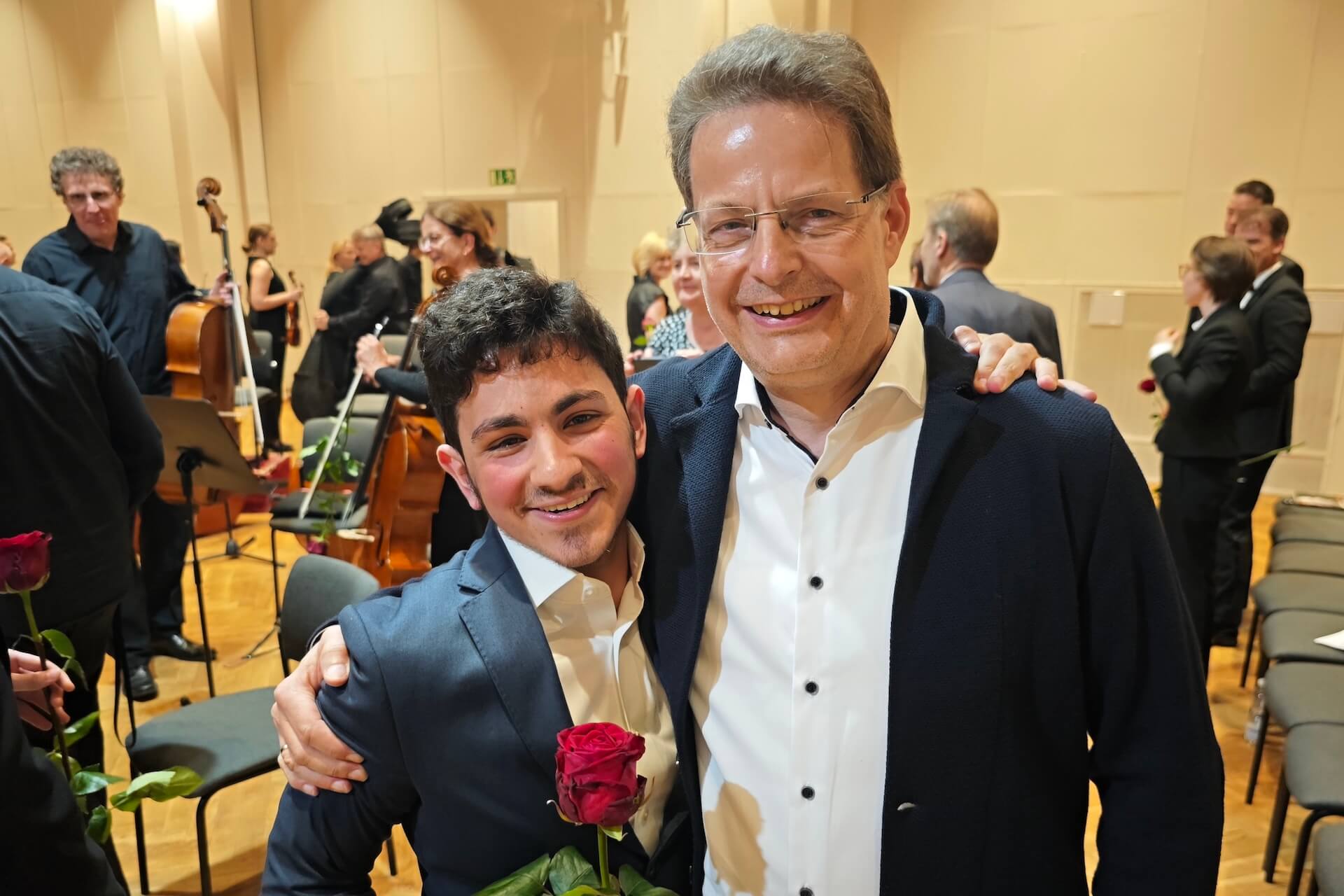
Joshua Raskin (left) left Prague as a "foster son" of Professor Sandmann.
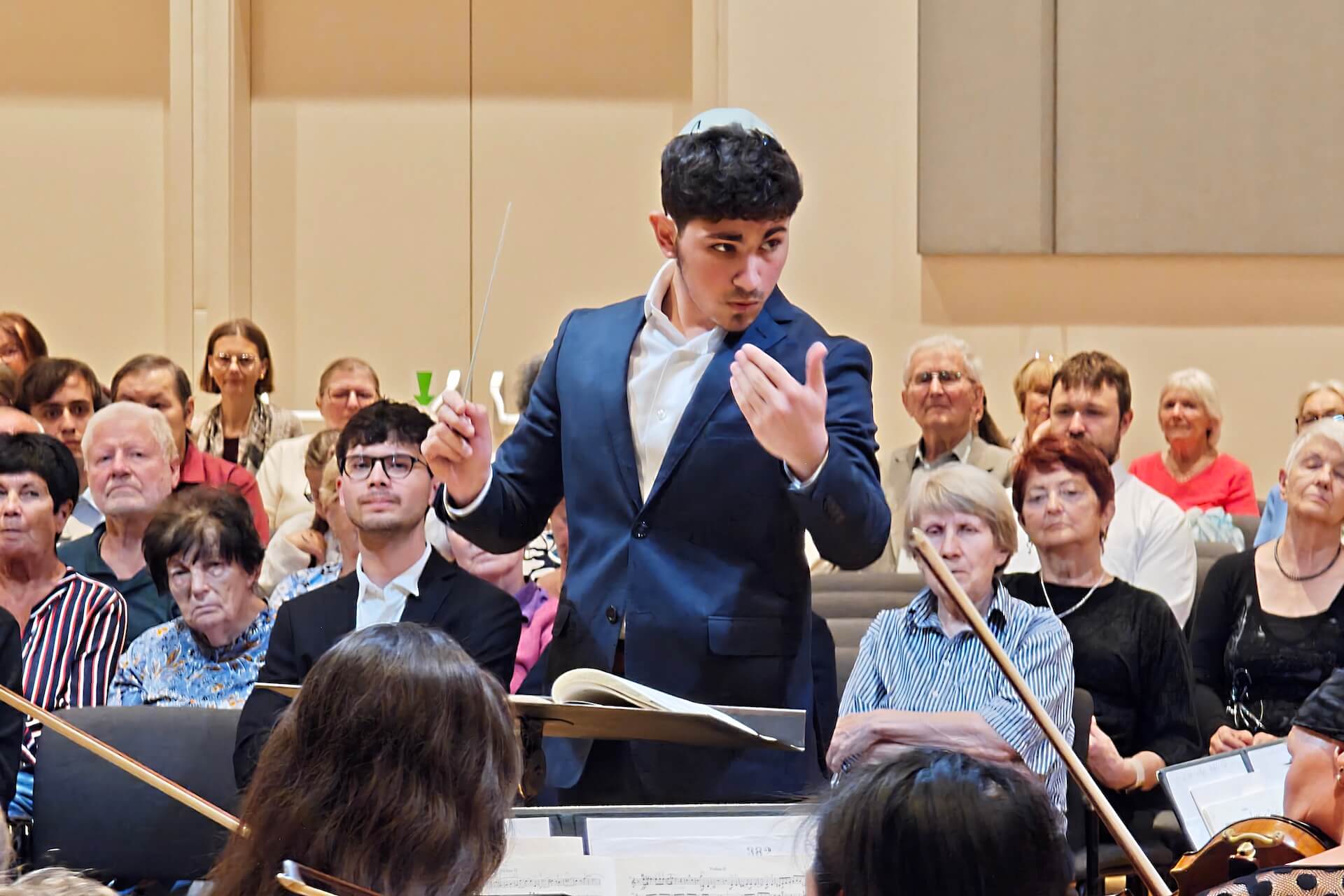
Joshua Raskin conducted the Prague Philharmonia in a free style.
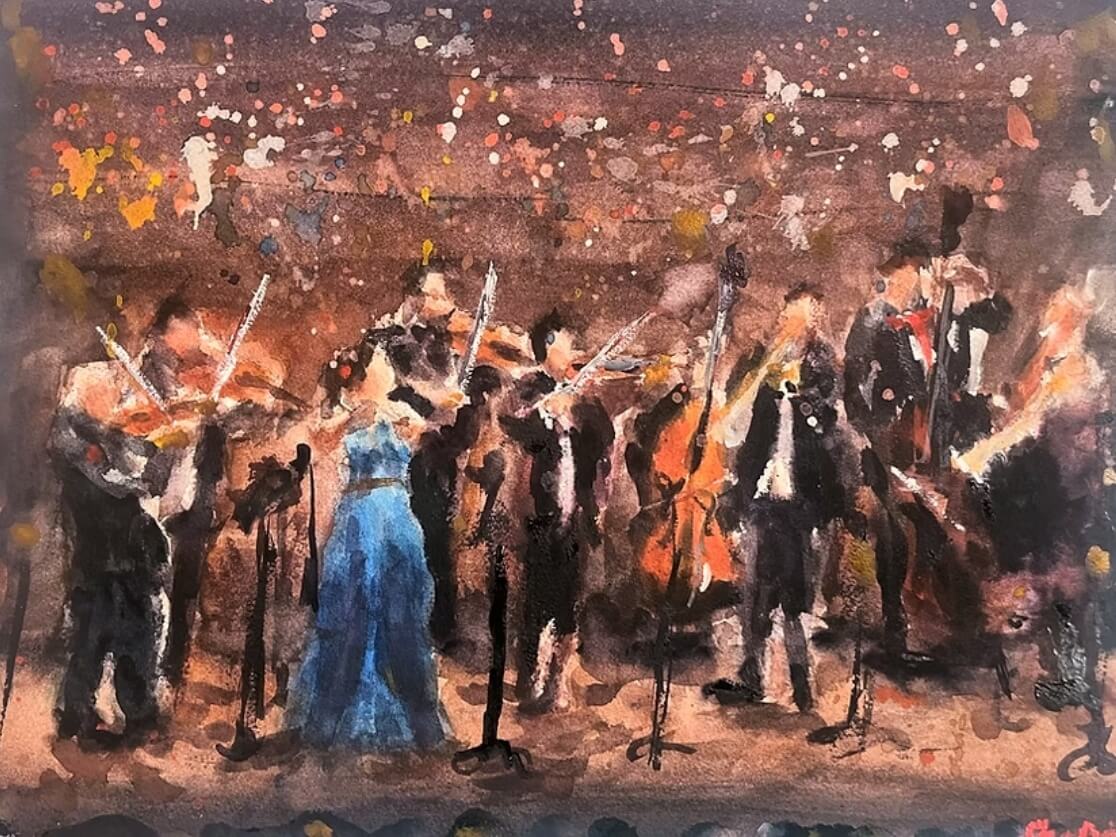
Musical motifs also permeate the paintings of Joshua Raskin.