For two Prague natives, Libeň, the old Jewish quarter, was one of those formative places during the First Republic era. Arnošt Lustig (1926–2011), the future world-renowned writer, screenwriter, and university professor, and Erik Polák (1929–1996), the future prominent historian and educator of the Terezín Memorial, were contemporaries. They were separated by only three years in age and by the fact that in their childhood, Arnošt lived in Lower Libeň while Erik lived in Upper Libeň.
However, they were united by much more than what divided them. For example, it was the environment of Jewish families that shaped their character from childhood. Later, it was the shared, several-year-long drastic experience of internment in the Terezín ghetto, Auschwitz, and other concentration camps. Arnošt was already an adult when he arrived, while Erik was still coming of age. It was not only unbreakable hope but especially their youth that helped them survive the hardships of Terezín and later other concentration camps. Simply put, they were deemed fit for forced labor in the work camps.
The exhibition, titled “I Want to Live Where I Love It,” tells this story. It commemorates this year’s 100th anniversary of Arnošt Lustig’s birth and the 30th anniversary of Erik Polák’s death. Furthermore, Lustig’s anniversary is included on the UNESCO list of significant anniversaries for the 2026–2027 period. Therefore, the exhibition is also part of the international multi-genre initiative FestivAL100, taking place in the Czech Republic and 11 other countries across four continents.
The initiator of the exhibition, Arnošt Lustig’s daughter Eva—co-founder of the Arnošt Lustig Endowment Fund and a documentary filmmaker—has been dedicated to developing her father’s legacy since his passing in 2011. She often remembers her father fondly: “Arnošt was proud of his Czech identity and his Jewishness. And most of all, he valued the human being. People connected with truth and sincerity. Good people. A person capable of giving the better part of themselves, because within each of us, there is both the better and the worse. By his very essence, Arnošt was a writer. He wrote so he could live. He lived so he could write. He wrote about what was in his blood, his heart, and his brain. He wrote every spare second. He wrote even when he wasn’t writing.”
In addition to the Arnošt Lustig Endowment Fund, the Music for Eternal Hope Endowment Fund—organizer of the Eternal Hope music festival—is also participating in the realization of the exhibition. The latter also cares for the legacy of Erik Polák. His significance lay not only in his role as a historian for the Terezín Memorial but primarily as the creator of the methodology for teaching the mission of the Jewish community in schools.
Polák’s son recalled his father: “Erik Polák always actively tried to improve the world around him. I formulated his message during a memorial meeting on the anniversary of his death in a sentence (it is more of a legacy): Work on not forgetting, do not forget. History, which he loved, studied, and dedicated his work to, shows many horrors and violence that we can hardly fully imagine today, let alone anticipate. However, in history, there is also the hope that even the greatest horrors will end and people will create a better world together. He did not speak much about faith; he was not convinced that eternal gods could limit the horrors of this planet.”
The exhibition is conceived as a selection of quotes from the literary works of both authors, reflecting the course of their lives. Arnošt Lustig is represented primarily by the audiobook CONFESSION (Multisonic, Prague 2005) and Erik Polák by the book Three Chapters (Sdělovací technika, Prague 2006, available as an audiobook on Supraphonline). The flow of events is then clarified by brief accompanying texts and photographs. It is fitting that the exhibition is installed in the Velký mlýn (Great Mill) in Prague-Libeň, a multifunctional cultural space that also houses a branch of the Municipal Library of Prague with a reading room. The exhibition can thus be visited not only by readers and experts on the works of both authors but also by attendees of concerts, lectures, and other cultural events taking place there. The exhibition is open from April 24, 2026.
Mgr. Svatopluk K. Jedlička

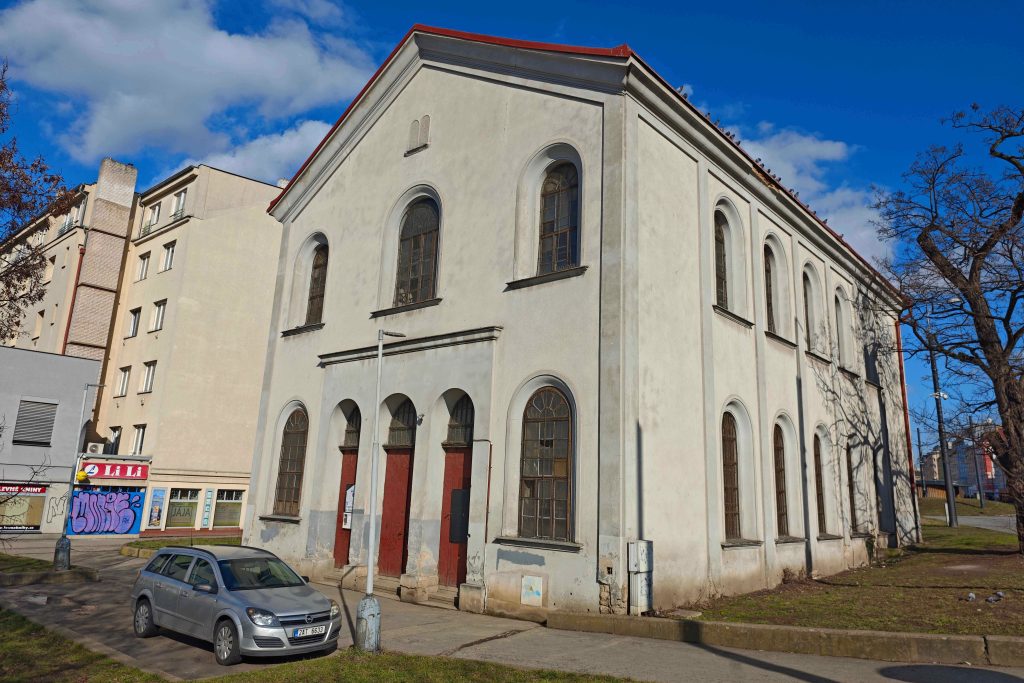
The New Synagogue in Libeň remains a reminder of the former Jewish town and the place where Arnošt and Erik met in their childhood.
(photo: Svatopluk Jedlička)
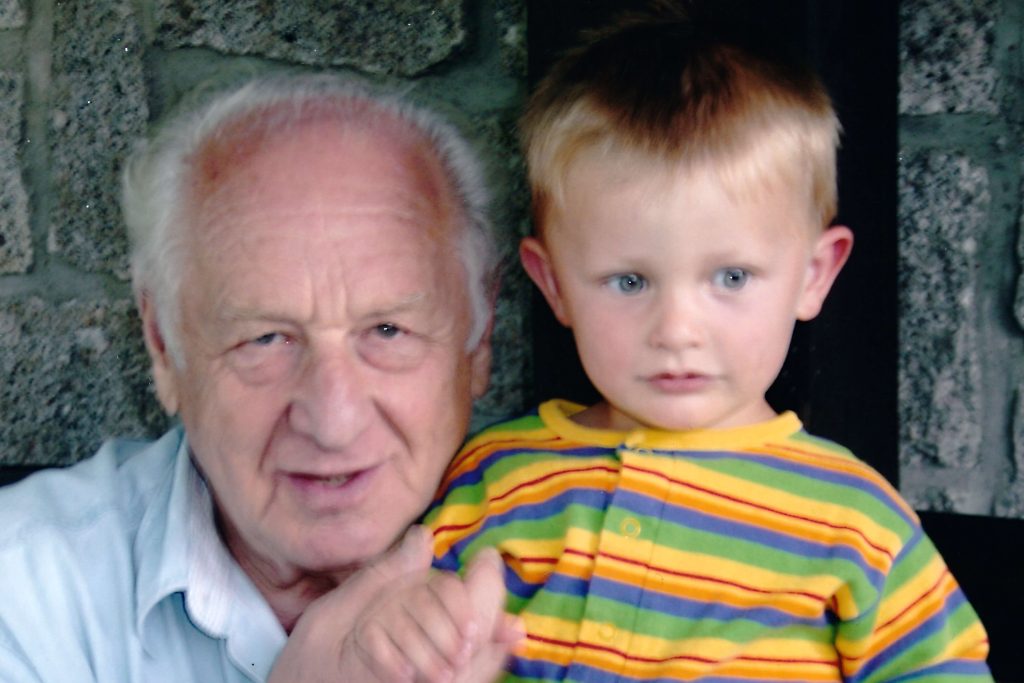
Arnošt Lustig with Erik Polák’s grandson in 2005 (photo: Polák family archive)
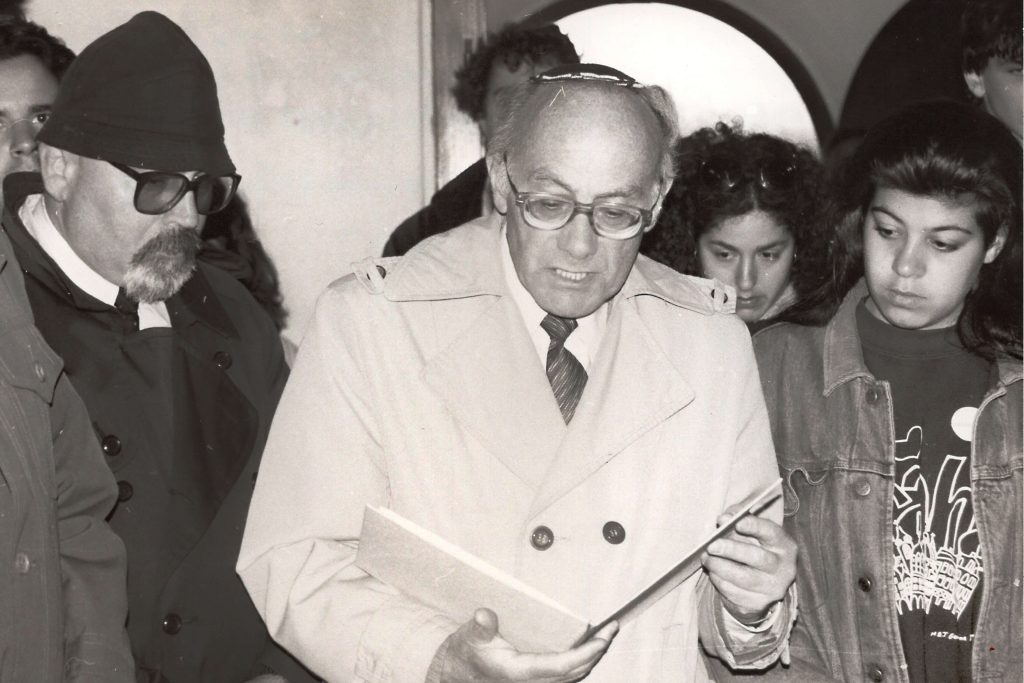
Erik Polák reading the names of Holocaust victims at the Jewish Cemetery in Terezín in 1993 (photo: Terezín Memorial archive)
The authors are responsible for the selection and presentation of the views and opinions expressed in the FestivAL100 project, which do not necessarily reflect those of UNESCO and do not commit the Organization.